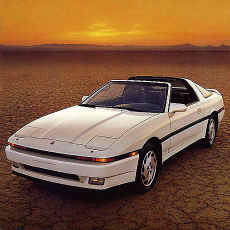
1986 May -1992 Toyota MK III
Supra Separates from the Celica line.
In mid-year 1986 Celica and Supra are officially separated, each becoming its own unique model line. The Celica became a front-wheel drive sport coupe, while the Supra retained it's image as a rear-wheel drive sports/GT car. The newly independent Supra is commonly referred to as the Mark III or MKIII.
The all new Supra is powered by a new 3.0-liter DOHC, inline-6, producing 200 horsepower (7M-GE). As part of it's new upperscale performance image the Supra becomes a showcase for Toyota technology, featuring such things as: four-wheel independent double-wishbone suspension and optional Toyota Electronically Modulated Suspension (TEMS).
In 1987 the Supra Turbo is introduced positioning the Supra as a high-performance GT. While the previous version of the Supra competed head-on with Mustangs and Camaros, the new Turbo model placed the Supra in direct comparison with the venerable Z-car, RX-7, and Corvette. The new engine for 1987 featured a turbocharged version of the 7M-GE engine appropriately labeled the 7M-GTE. This intercooled 6-cylinder engine produced 232 horsepower: 32 more than the normally aspirated (NA) version. Continuing as a showcase of technology the new Turbo model offers anti-lock brakes (ABS) for the first time.
1986 May
Supra model is newly introduced as a free standing model no longer associated with the Celica. Originally scheduled for a 1986 debut, production delays cause the model to be introduced mid year (hence the 1986.5 designation). Power for the all new Supra is from a 200 hp, 3.0 liter DOHC inline six cylnder. Notable features include an electronically controlled independent suspension going by the moniker, Toyota Electronic Modulated Suspension (TEMS), and a removable Sport-Roof panel.
1987
First Supra turbo model is introduced. The intercooled, turbocharged engine boosts hp to 230 and torque to 246 ft-lbs. Other unique features of the turbo are an engine oil cooler and integrated rear spoiler. The sports package, which is standard on the turbo and optional on the base model, offers limited slip differential (LSD), TEMS, and headlamp washers. New Anti-lock Braking System (ABS) available as an option on all models.
1988
Models carried over from 1987 with only minor changes. Base interior changed from vinyl to cloth. Minor engine modifications to improve quietness. Beige/Brown two-tone paint option is dropped.
1989
Model receives a freshening with a new grille, air dam, taillights, and rear spoiler. Turbo motor upped to 232 hp, torque increased from 246 to 254 lb-ft with intake, wastegate, and turbo modifications. Speed sensitive power steering added. Rear suspension rates increased. Cruise control moved to steering wheel spokes.
1990
Driver's side airbag made standard. Cruise control moved back to column mounted stalk. Fluid filled engine mounts added for smoothnes. Power steering boost trimmed for more feel at high speed.
1991
New five-spoke wheels with Goodyear GS-D Z-rated tires are made standard. ABS standard on turbo models. Outer-sliding power sunroof option added; Sport-Roof and pop-up sunroof still offered.
1992
Last year of the third generation. Automatic transmission shift points revised. A ten-speaker sound system added as an option with the ETR/Cassette/CD system. Two new colors added; Teal Metallic and Garnet Pearl (White Pearl, Silvermist Metallic and Burgandy Pearl are dropped)